
The emails I get these days from NGOs are nothing like the ones I used to get only a few years ago, when they talked about money so discreetly you would barely realize that was what they meant by those elegant phrases about partnership, leadership, empowerment or vision.
“This is no drill”, a recent email reads, if only between the lines. “Do you know anyone in person at any of the foundations in this list? Do you know any of these rich celebrities?” One celebrity’s name is misspelled. Nerves are lying blank. The NGO has lost around half of its funding in the last two years. Not, however, because of what Trump and Musk did to USAID. The NGO that sent the email never touched any US government funding. Its European bilateral donors enabled the NGO to fly high for about a decade, and then bottom out.
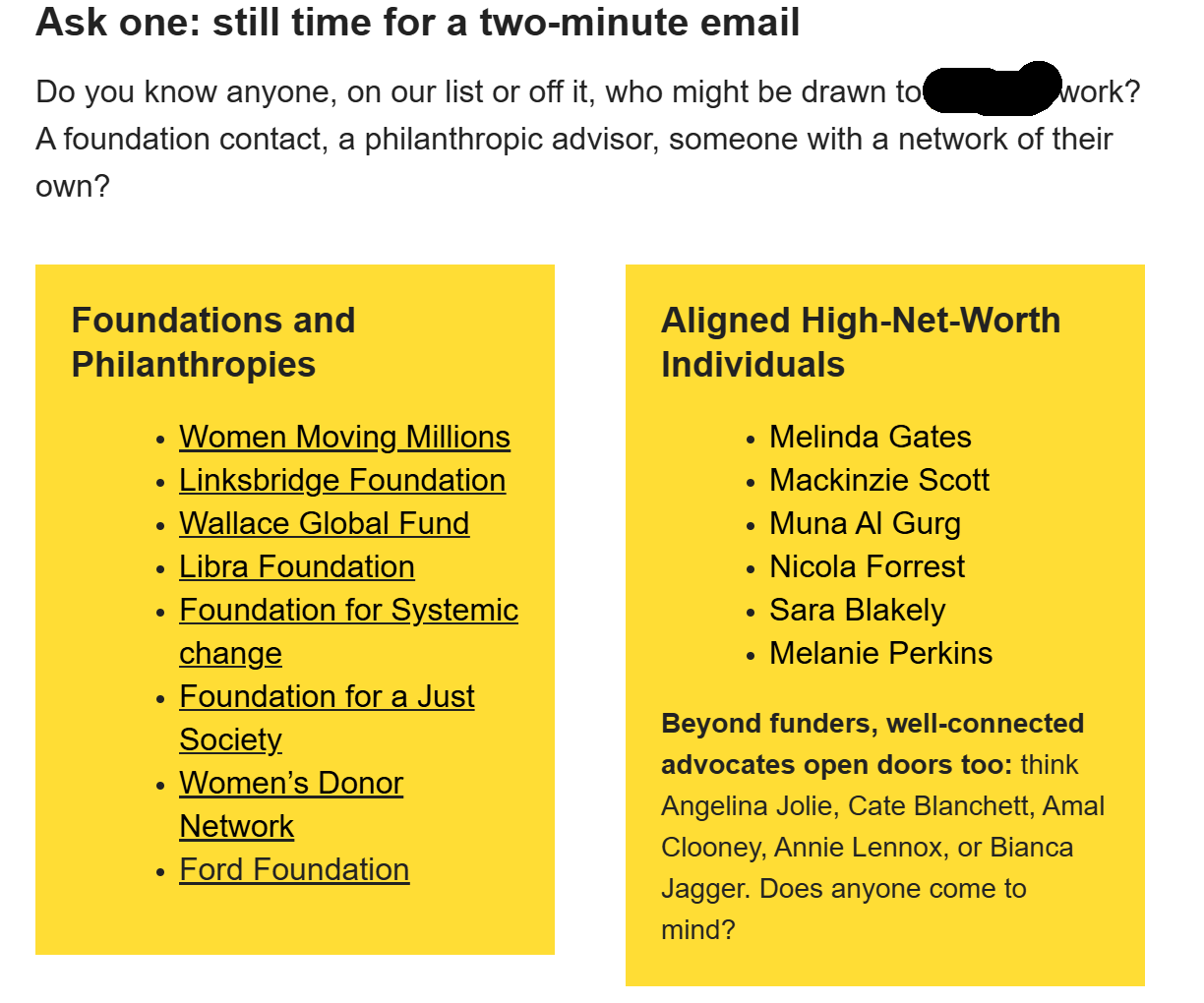
The NGO (whose acronym I blacked out in the screenshot) has been around for more than a hundred years. For most of that time, it wasn’t what we would today consider an NGO. It had hardly any salaried staff. Its few paid staff were not professionals trained at elite universities in novel NGO-specific fields, but seasoned activists who got elected by other members to the job for a term. It had no grants and certainly no bilateral ones from governments it used to call out, not “partner with”. It had no projects.
But it did have a network of national and local chapters spanning much of the globe, whose actions and ideas unnerved powerful governments, again and again. The chapters are still there, and some of their members are almost as old as the organization, though these days young members in their 20s bring their knitting to their congresses.
The chatter in the chapters is sympathetic to the worries of the professional salaried officers in the secretariat, but also bemused. The members cannot quite see why winding down a few high-flying years of grant-funded projects (that the chapters had little say in or benefit from) should mean imminent apocalypse. The chapters have been there through two world wars, one cold war and too many economic crises to count, and they are still here today.
The end of the age of the NGO looks like frantic fundraising emails that ask “do you know a rich celebrity?” instead of “will you donate to us?”, upbeat posts on LinkedIn about a new career, workshops about how to sell project management skills to corporate buyers instead of foundation donors.
Foreign-aid funding for other countries’ civil societies has been a phenomenon and a modus operandi of the unipolar moment, and therefore, NGOs in their stereotypical, NGO-ized form are creatures that evolved to inhabit this particular temporal ecosystem. The unipolar moment winds down with Western societies facing all sorts of imperial boomerangs, and one of them is the NGO.
That sort of NGO. The one with the grants and the projects, the professionals with the esoteric skills sets and white-collar salaries, with the sidelined members or no members at all, the one coming out of nowhere to suddenly take up a large space in our public square that no one remembers giving to them. Western donors engineered that type of NGO in the global south or the post-communist east, and then it crept back into their own, creaking democracies a generation later.
This sounds like a stretch. After all, Western societies entered the unipolar moment with rich organized civil societies, some of them going back hundreds of years, underpinned by legal frameworks that enabled these institutions to thrive and become pillars of society and simultaneously its movers and shakers. But think of it this way: when was the first time you remember a Western politician, public intellectual, journalist or expert referring to Western organizations operating entirely inside Western countries as “NGOs”? Not all that long ago, right? Maybe sometime in the 2010s, maybe even later.
Before then, we had other words, words that emphasized these organizations’ associational nature, like the German Verein (which translates to something like “the coming together”), or their compassionate character as in the English charity, or the more technical descriptive not-for-profit that sets them apart from the vast majority of legal persons, which have a commercial purpose. Calling them a non-GOVERNMENTAL-organization would have been odd, like stating the overly obvious which is also utterly beside the point.
In the late 1980s and 1990s, when bilateral donors determined that NGOs would be the key new actors of international development - and international affairs more broadly - and began to ratchet up their investment in them, the term NGO - Non-Governmental Organization - deliberately highlighted what NGOs were not: this foreign aid was not going into the coffers of foreign governments, so they could do the things governments ought to do to lift up their people, like build roads and hire teachers. It also wasn’t donor governments and their civil servants directly implementing the projects they paid for; that was passé, too. The key characteristic of these new actors was that they are were not governmental, as opposed to being charitable, associational or non-commercial.
At that time, however, the term was reserved for entities operating outside the West, but with Western money. A Western official fluent in development aid lingo might use “NGO” a dozen times a day, but would never refer to their own country’s ACLU, Caritas or Women’s Institute that way. It would have felt absurd.
People began to call domestic non-profits “NGOs”in the West long after that term had acquired its tarnish in development settings. “NGO” entered Western domestic discourse, about Western domestic realities, with a derogatory flavor, pre-loaded with the meaning of NGO-ization: elite institutions remote from the people but close to power, their ideas esoteric, their twee projects easy to ridicule, staffed by those elites we keep overproducing, unaccountable for the sway they inexplicably hold over our politics and public square, at best irrelevant, at worst opaque manipulators, often preachy and presumptuous.
It wasn’t the perceptions that traveled via imperial boomerang from the aid-recipient part of the world into ours; the phenomenon of the NGO-ized NGOs had. Critically, this does not apply to the likes of Caritas, the Women’s Institute, the ACLU or newer movements like Attac, which share a business model of large numbers of small donations from average people.
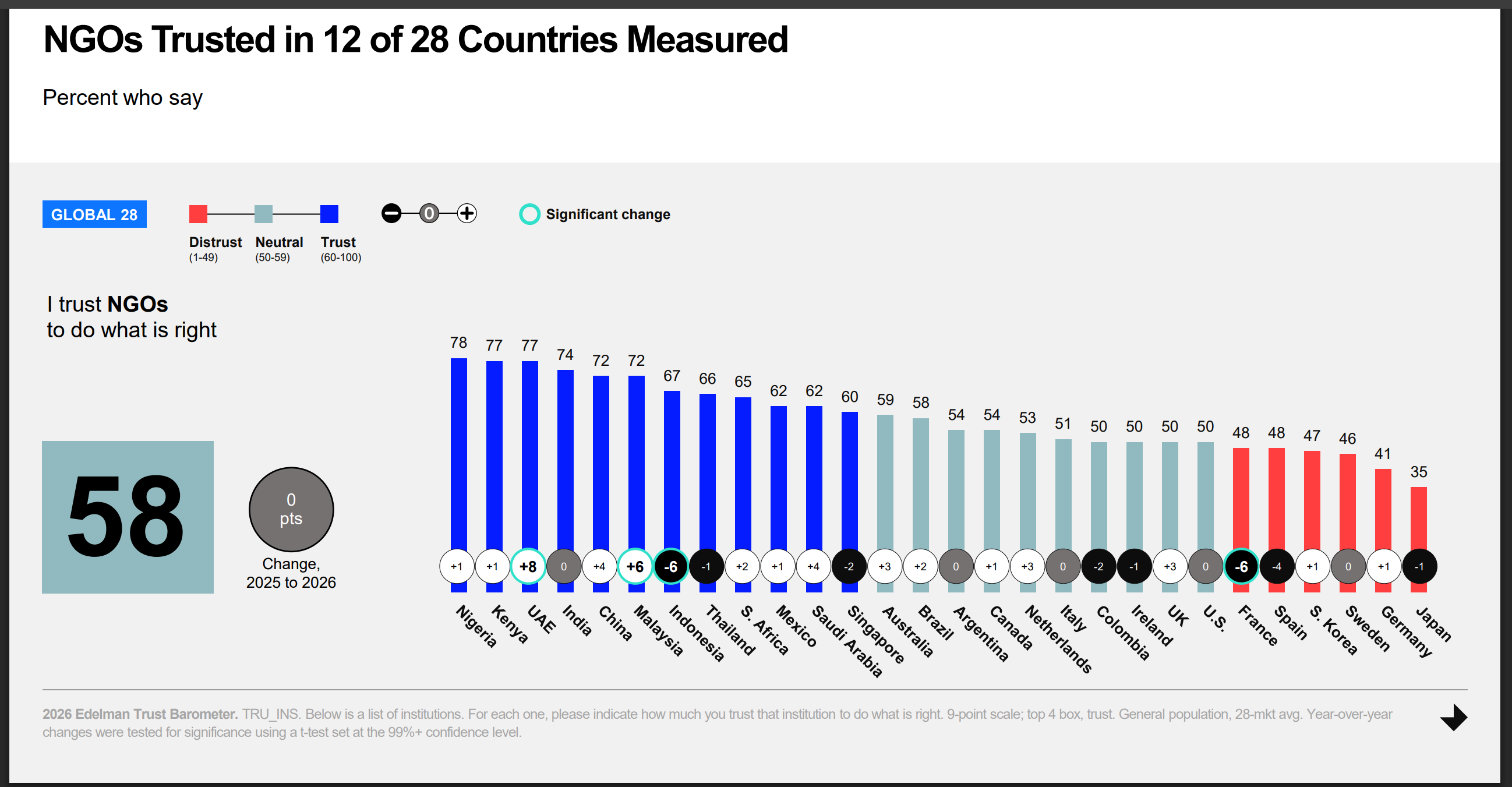
Instead, a new, very specific variant of NGO popped up in Western democracies by the 2010s: precision-engineered by high-flyers (a decade earlier, we would have called them social entrepreneurs) and often spun off from their work in government or media, debuting with large grant contracts already signed or as immediate brainchildren of foundations and governments, cozily close to power and the centrist consensus, skipping the associational or charitable thing, their mission and practice almost never in service provision or community-building, but in setting agendas. Their rise coincided with the exploding demand for debunkers who would battle all that disinformation. By 2026, trust in NGOs was significantly lower in high-income democracies than in developing countries.
If the end of the unipolar moment means the end of the age of the NGO, what comes after?
In a podcast this summer, the host asked me whether western donor countries had started cutting their foreign aid and especially so to NGOs because they realized that “the lie” was over. I’m not sure what he meant by “the lie”. Maybe that foreign money cannot grow truly independent “vibrant” civil societies, and donors had to admit this to themselves, or had been found out?
I got distracted and went off on a tangent, about how all foreign aid begins with a lie, namely that developing countries pay more interest on debt, which flows back to donor states, than they receive as foreign aid, and I forgot to answer why I actually think funding to NGOs has been cut so much: it had become clear to donor governments that it wasn’t working for them in the way they had imagined. It wasn’t delivering the effortless hegemony it was supposed to. Financing other countries’ faux civil societies proved an ineffectual tool. For a while and in a few countries it looked like it might just work, like you could create from scratch, or at least capture, a country’s entire political class and also its media, education and arts, and then that country would be a reliable and enthusiastic satellite in all the ways that really matter. And then it went pear-shaped, even in those few countries.
We now find ourselves in a starker, more nakedly violent, more competitive, fast-moving and seismically active era. Why channel grants to NGOs, if you can just kidnap a nation’s leader, seize control of its resources and run the place as an imperial viceroy? Why nurture cohorts of leaders, with the return on the investment uncertain and far off, if you can just gun-boat countries into compliance? Why outsource strategic communication to influencers in cardigans, if you can just have your in-house spooks scare your public into submission? In a rough-and-ready age like ours, why waste time and up to a third of your budget on Monitoring, Evaluation & Learning, why keep sending burnt-out activists on yoga retreats?
The unipolar moment may be ending, but it is holding on for dear life. It is going to be a long, drawn-out, ragged end. We may not even realize it when the next thing has begun. But the question remains: what will happen to the NGOs as a phenomenon, to a way of being in the world, to an industry and the professions and graduate degrees it spawned, to a lifestyle? What will happen to these peculiar institutions, that so conspicuously carry the label “non-governmental”, but are so closely tied to what governments want to accomplish in the world? How will NGOs perceive this moment and try to cope?
All systems of power create institutions that reproduce and shore up the formers’ power. Sometimes, the powerful at the top of the system draw on institutions that existed before, enlist them into alliances of mutual benefit, sometimes they create new ones. Over the course of their existence, these institutions acquire power of their own, infrastructure, autonomous control over resources and their own lore. When the systems of power that gave rise to these implementing agents wane, the latter will try to absorb the shock, adapt, transform and go on.
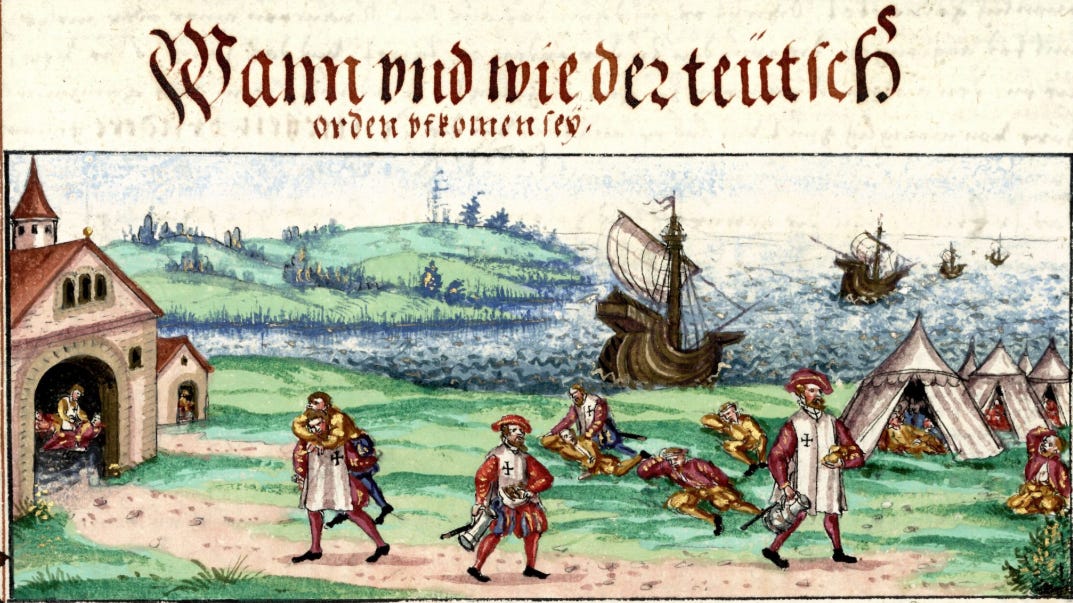
In the course of the third crusade in the late 12th century, during the siege of Acre, German crusaders from the Hansa cities of Bremen and Lübeck founded a hospital. Through the favor of powerful nobles and the recognition of the pope, they quickly became a knightly order, the Teutonic Order, with significant possessions around the Mediterranean and soon also north of the Alps in the Holy Roman Empire. As the age of the crusades in the Holy Land drew to a close, they turned their sights to Eastern Europe and then the Baltic region, where they founded their own state. They fought the pagan Prussians and Lithuanians, the Rus, under their prince Alexander Nevskii, and again the now Christian Lithuanians and their allies, the Poles. The order’s state lasted until the 16th century, when its last Grand Master secularized it and made himself the duke of what was henceforth Prussia.
The Teutonic Order kept reinventing itself, as Catholic, Protestant and mixed territorial entities dotting Europe from today’s Estonia to the Alps, building castles, churches and hospitals everywhere, and for a brief time even running a bank. At times, it revived its military function and finally endowed it to name-sake regiments that exist in European national armies to this day. Following Napoleon’s defeat, the order was briefly dissolved, but soon reinstated by Austrian emperor Francis I.
The Teutonic order was created by the social entrepreneurs of its day to perpetrate imperialist violence at one periphery of Europe, then moving on to violent settler colonialism on another periphery, on behalf of other powers, but also on its own. It garnered plaudits and prestige for doing the lord’s work and undoubtedly believed in the goodness of its cause, that war and conquest were its spiritual and missionary duty. Along the way, it generated states and sustained royal and imperial dynasties and was boosted by them in turn. It became fabulously rich and intermittently bankrupt. It was Catholic by default, then Protestant, then both and today is Catholic again.
Today, the order has more than 1,000 members, some of them priests and women religious, most of them lay members, so-called “familiars”. It maintains properties and chapters in Germany, Austria, Italy, Slovenia, Slovakia and the Czech Republic. The Teutonic order is anachronistic institution, borne out of a highly specific but relatively brief period in time, but through its innate adjacency to power it has had the assets and agency to survive over centuries.
These days, it considers itself a charity.
A stone’s throw from Vienna’s iconic St Stephen’s Cathedral, a handsome 17th century city palais dating back to the late Middle Ages, the Deutschordenshaus, is the seat of the order’s Grand Master and houses its treasure chamber. Continuing the tradition of pilgrims’ hospitals, it is also the order’s guest house: a hotel, with simple, sun-dappled rooms, at a sensational price for this prime location.
Medieval knightly orders and their reinvention over the centuries seem a far-fetched analogy to the current crisis of the transnational NGO industry. But reading those frantic fundraising emails, the crisis response plans, the grimly upbeat LinkedIn posts, brings up an image in my mind.
I have watched NGOs calcify as they retrench during crises. When funds run dry and it looks like it is for good, NGOs offload junior before senior staff; field offices before headquarters; women before men. “Last in, first out” means that the more established and privileged get to stay, and those who had to struggle to be there must go. Only recently, when the NGO heyday was already bending into its sunset, did many NGOs begin to practice the “nothing about us without us” they had been preaching, hiring grassroots activists from poor, migrant, racialized or otherwise marginalized backgrounds, survivors of war, violence and oppression. When these people are being dropped, their fall will be precipitous.
NGOs, even the NGO-ized ones, will not vanish as a thing. They have scraped together too many assets for that, accrued too much residual power, intermarried with nobility, become part of the furniture. The image flashing across in my mind is of a dried-up priestly caste, persisting in archaic rituals behind thick walls long after everyone else has lost their religion.